Councils have 8 weeks to decide on your planning application. But what happens when they can't — or won't — meet that deadline? They ask for "Further Information." And our data shows this isn't always about needing more details.
The Pattern Is Unmistakable
We analysed 55,067 planning applications from the last 5 years (excluding two councils with data quality issues). When we looked at when councils send Further Information requests, a stark pattern emerged:
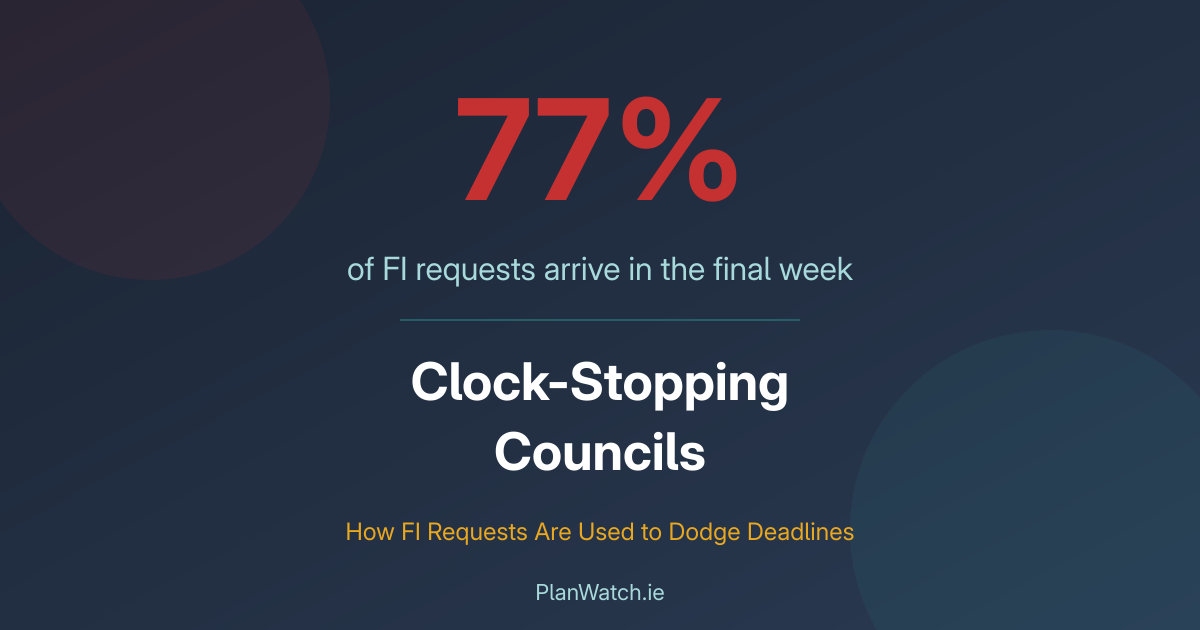
81.5% of all FI requests arrive in weeks 6-8 — the final stretch before the statutory deadline.

If councils genuinely needed more information to assess applications, you'd expect a more even distribution. Instead, over 4 in 5 FI requests arrive in the final fortnight — precisely when the clock is about to run out.
The Clock-Stopping League Table
Some councils are worse than others. Here are the authorities that most consistently send FI requests right at the deadline:

The Worst Offenders (% of FI in final week):
- Offaly: 98.4%
- Roscommon: 97.9%
- Dublin City: 97.1%
- Meath: 94.0%
- Galway County: 93.4%
- Kilkenny: 93.4%
The Better Performers:
- Longford: 39.2% in final week
- Louth: 58.8% in final week
- Donegal: 62.3% in final week
The contrast is striking. Longford sends FI requests across a broader timeline — not clustered at the deadline. Offaly waits until the last possible moment, every single time.
Dublin City: Fast to Refuse, Slow to Help
Dublin City Council presents an interesting case study. They have one of the lowest FI rates in the country — only 11.8% of applications get an FI request.
But when they do send FI, 97.1% arrive in the final week.

This suggests Dublin City has two modes:
- Quick refusal — Application rejected, no FI needed
- Deadline dodge — Complex application, use FI to buy time
For applicants, this means: if Dublin City hasn't decided by week 6, expect an FI request — and a much longer wait.
The Real Cost: Nearly 4 Extra Months
FI requests don't just reset the clock. They fundamentally change how long your application takes.
- Without FI: Average 52.4 days to decision
- With FI: Average 164.6 days to decision
That's an extra 112 days — nearly 4 months — added to your timeline.

For developers, this means higher holding costs. For homeowners, it means months of uncertainty. For builders, it means missed construction windows.
Is This Getting Better or Worse?
Looking at the 5-year trend (% of FI requests in weeks 6-8):
- 2021: 87.1%
- 2022: 84.7%
- 2023: 84.6%
- 2024: 82.9%
- 2025: 82.0%
There's a slight improvement — the percentage has dropped 5 points over 5 years. But the pattern remains dominant. Despite rhetoric about planning reform and speeding up decisions, the overwhelming majority of councils still send FI requests in the final weeks.
Why This Matters
The 8-week statutory deadline exists for a reason — to give applicants certainty. When councils routinely circumvent it with last-minute FI requests, that certainty evaporates.
The data suggests two things:
- Resource constraints: Some councils may genuinely lack capacity to assess applications within 8 weeks
- Strategic behaviour: Using FI as a safety valve to avoid missing statutory deadlines
Either way, applicants pay the price.
What You Can Do
- Frontload your application. Submit comprehensive documentation upfront. Don't give them reasons to ask for more.
- Know your council. Applying in Offaly or Roscommon? Budget for an FI request. Applying in Longford? You're more likely to get early feedback.
- Respond quickly. Once you get an FI request, speed matters. Our data shows faster responses correlate with higher approval rates.
- Track your timeline. If you're approaching week 6 with no decision, an FI request is coming. Prepare for it.
The Councils That Get It Right
Credit where it's due. Some councils demonstrate that it's possible to run a more balanced FI process:
- Longford: Only 39% of FI in final week — a clear outlier
- Louth: 59% in final week — better than most
- Donegal: 62% in final week — room for improvement, but ahead of the pack
These councils prove the pattern isn't inevitable — it's a choice.
Data note: This analysis excludes South Dublin and Fingal councils due to data quality issues affecting FI timing records. Analysis covers 55,067 valid applications from 29 councils.
Data source: Planning applications from 2021-2026, scraped daily from Irish local authorities.
Is your application stuck in FI limbo? Search our database to track your application's status, or set up alerts to get notified the moment a decision is made.